What Is a Passive Preamplifier?
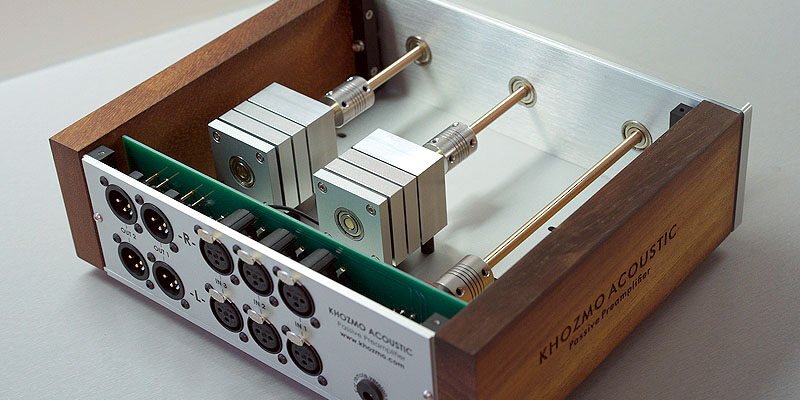
A passive preamplifier is a volume and source-selection control with no active gain stage — no tubes, no transistors, no op-amps in the signal path. At its simplest, it’s a potentiometer or stepped attenuator wired between a source component and a power amplifier, sometimes paired with a switch for input selection. Unlike an active preamp, which buffers and often amplifies the incoming signal, a passive preamp only attenuates it: output level is always equal to or lower than input level, never higher.
This minimalism is the entire value proposition. Every component in an audio signal path adds some combination of noise, distortion, and coloration. A passive preamp removes an entire active gain stage from that chain, and with it, an entire category of potential signal degradation.
Core Technical Advantages
1. Elimination of Active-Stage Distortion
Every active gain stage — tube or solid-state — introduces some level of harmonic distortion, even when well-designed and operating well within its linear range. Total harmonic distortion (THD) figures for a competent active preamp typically run from 0.001% to 0.01%, but that number is never zero, and it compounds with every other active stage in the chain (DAC output stage, phono stage, power amp input stage). A passive preamp contributes effectively zero additional harmonic distortion of its own, because there’s no active device to generate it. The signal path is resistive attenuation only — the audio equivalent of a straight wire with volume control.
2. No Added Noise Floor
Active gain stages generate broadband noise as an unavoidable consequence of amplification — thermal noise in resistors, shot noise in semiconductor junctions, and flicker noise at low frequencies all contribute to a preamp’s noise floor, typically specified as a signal-to-noise ratio (SNR) or equivalent input noise (EIN). A passive preamp’s only noise contribution is the Johnson-Nyquist thermal noise of its resistive elements, which is orders of magnitude lower than what any active gain stage adds. For systems built around high-output source components (most modern DACs output 2V or more), this means a passive preamp can deliver a genuinely quieter signal path than even a well-executed active design.
3. No Phase Shift or Frequency-Dependent Coloration from Active Circuitry
Active preamps, particularly those using feedback loops, can introduce frequency-dependent phase shift and subtle amplitude deviations across the audio band, especially near the extremes of their bandwidth. A passive attenuator built with quality resistors is effectively flat and phase-linear across the entire audio spectrum and well beyond it — its frequency response is governed almost entirely by the interaction between its output impedance and the capacitance of the downstream cable, not by any active circuit limitation. Properly implemented (see the impedance-matching section below), this interaction is negligible.
4. Reduced Component Count and Higher Reliability
Fewer parts in the signal path means fewer failure points, fewer things to age or drift out of spec, and simpler fault diagnosis. Active preamps require power supplies, which introduce their own noise and reliability considerations — power supply rejection ratio (PSRR), ripple, regulation under load, and the long-term degradation of electrolytic capacitors. A passive preamp built around a stepped attenuator or quality potentiometer has none of these dependencies. There’s no power supply to fail, no capacitors to age, and no bias points to drift.
5. Transparency by Subtraction, Not Addition
The audiophile principle often summarized as “the shortest signal path is the best signal path” finds its purest expression in passive design. Where active preamps aim for transparency by minimizing the audible signature of necessary amplification, passive preamps achieve it by removing the need for amplification in that stage altogether. This is why passive preamps are frequently described as sounding neutral, uncolored, or simply “out of the way” — there’s no active circuitry imposing its own sonic signature, because there’s no active circuitry.
6. Superior Channel Separation and Crosstalk Performance
Active preamps with shared power supply rails or physically proximate gain stages for left and right channels can suffer from crosstalk — signal bleeding between channels. A well-laid-out passive attenuator, particularly a stepped or ladder design with independent channel paths, achieves crosstalk figures that are difficult for active circuits to match, simply because there’s less shared circuitry and no shared power rail modulation between channels.
7. Cost-Effective High Performance
Because a passive preamp eliminates an entire gain stage’s worth of active components, power supply, and regulation circuitry, high measured performance is achievable at a fraction of the cost of an equivalent active design. A well-executed stepped attenuator using precision resistors can outperform active preamps costing many times more, on pure measurement criteria like THD, noise floor, and channel separation.
Conclusion
The technical advantages of passive preamplifiers — near-zero added distortion, minimal noise contribution, phase linearity, high reliability, excellent channel separation, and strong cost-to-performance ratio — all stem from the same underlying principle: the best way to avoid degrading a signal is to not process it more than necessary. For systems with well-matched impedances and healthy source output levels, a passive preamp isn’t a compromise; it’s often the more accurate choice on paper and in listening tests alike.