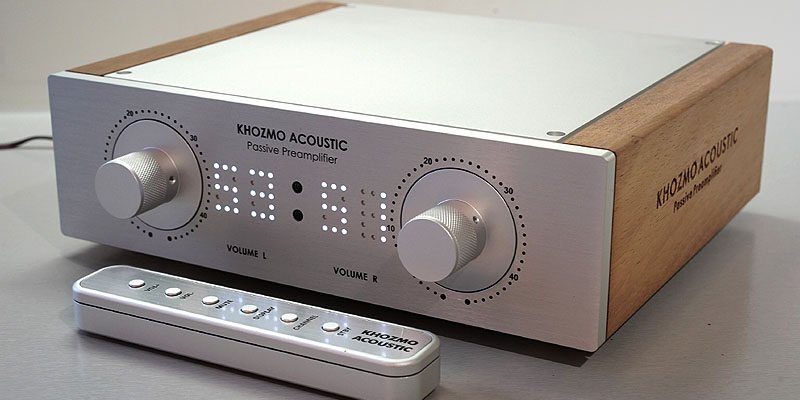
In the world of high-fidelity audio, simplicity often delivers the best results. A passive preamp with remote control combines minimalist signal handling with modern convenience, making it a compelling choice for audiophiles who want transparency without sacrificing usability.
What Is a Passive Preamp?
A passive preamplifier (or passive preamp) is a device that controls volume and input selection without active amplification components. Unlike active preamps, it doesn’t require a power supply to boost the signal. Instead, it uses components like:
- Resistors (in stepped attenuators)
- Transformers (in transformer-based passive units)
Because it doesn’t amplify the signal, a passive preamp introduces virtually no noise or distortion, preserving the original sound quality.
Why Add a Remote Control?
Traditionally, passive preamps are fully manual. However, modern designs now include remote control functionality, offering:
- Convenient volume adjustment from a distance
- Input switching without leaving your seat
- Better integration into contemporary home audio systems
This combination of purity and convenience makes passive preamps with remote increasingly popular.
Key Benefits of Passive Preamp with Remote
1. Exceptional Sound Transparency
Without active circuitry, the signal path remains clean and uncolored. This results in:
- Greater detail retrieval
- Improved stereo imaging
- More natural sound reproduction
2. Zero Added Noise
No power supply means:
- No electrical interference
- No hum or hiss
- Ideal for high-sensitivity systems
3. Energy Efficiency
Passive preamps consume little to no power (except minimal power for remote control systems), making them eco-friendly.
4. Modern Usability
Remote control eliminates the biggest drawback of traditional passive units—manual operation.
How Remote Passive Preamps Work
To enable remote functionality, manufacturers typically add:
- Motorized potentiometers: A small motor adjusts the volume knob when you use the remote
- Relay-based stepped attenuators: Electrically controlled resistors switch levels precisely
- Infrared (IR) or RF receivers: Allow communication between remote and unit
These additions require a small power source, but importantly, the audio signal path remains passive.
Who Should Use a Passive Preamp with Remote?
This type of device is ideal for:
- Audiophiles seeking maximum transparency
- Systems with high-output sources (DACs, CD players)
- Power amplifiers with high input sensitivity
- Users who want minimalist setups with modern convenience
Passive vs Active Preamp: Quick Comparison
| Feature | Passive Preamp | Active Preamp |
|---|---|---|
| Signal amplification | ❌ None | ✅ Yes |
| Noise level | Very low | Moderate (depends on design) |
| Power requirement | Minimal | Required |
| Sound coloration | Minimal | Possible |
| Remote capability | Available (modern units) | Common |
What to Look for When Buying
If you’re considering a passive preamp with remote, focus on:
- High-quality attenuator (stepped or transformer-based preferred)
- Reliable remote system (IR vs RF depending on setup)
- Solid build quality (shielding and connectors matter)
- Impedance compatibility with your system
- Short signal paths and premium components
Final Thoughts
A passive preamp with remote offers the best of both worlds: audiophile-grade signal purity and everyday convenience. While it requires careful system matching, the reward is a transparent, noise-free listening experience that stays true to the original recording.
If your system is compatible and you value clean sound above all else, this could be one of the most impactful upgrades you can make.
Khozmo Passive Preamp with Remote: Advanced Audiophile Guide
In the high-end audio world, few components embody purity like the Khozmo Acoustics passive preamp with remote. Designed for signal transparency and precision volume control, Khozmo units have become a reference choice for audiophiles seeking zero coloration, relay-based attenuation, and modern usability.
This advanced guide explores architecture, technology, performance, and system synergy—helping you determine whether a Khozmo passive preamp with remote is the right upgrade for your system.
What Makes Khozmo Passive Preamps Unique?
Unlike generic passive controllers, Khozmo preamps are engineered around high-precision attenuator technology and modular design.
Core Design Philosophy
- Fully passive signal path (no gain stage by default)
- Relay-based stepped attenuators instead of traditional potentiometers
- Remote-controlled volume without degrading signal purity
- Modular options: stereo, dual mono, transformer (AVC), and hybrid active/passive
Khozmo emphasizes neutral, detailed, and accurate sound reproduction, ensuring the signal remains untouched from source to amplifier .
Remote Control Implementation: No Compromise Engineering
One of the biggest challenges in passive design is integrating remote functionality without polluting the signal path.
How Khozmo Solves It
- Relay-based ladder or shunt attenuators (64-step precision)
- Microprocessor-controlled switching (isolated from audio path)
- Dedicated power supply only for control circuitry
- Physical relays replace resistive tracking errors of pots
This means:
➡️ The audio signal remains 100% passive
➡️ Remote operation does not introduce noise or distortion
In fact, even in remote versions, the power supply is used solely for control—not amplification .
Attenuator Technologies Explained
Khozmo offers multiple attenuator types—this is where most of the sonic differences lie.
1. Ladder Attenuator
- Separate resistors for each step
- Extremely precise channel matching
- Options include Vishay, Z-Foil, AMRT, AMRG resistors
- Best for: reference systems
2. Shunt Attenuator
- Signal passes through one fixed input resistor and variable to GND
- Slightly more dynamic and “direct” sound
3. Series Attenuator
- Simplest design
- Lower cost, but less precise
- Constant input impedance
4. AVC (Autoformer Volume Control)
- Transformer-based passive control
- Improves impedance matching
- Often delivers better dynamics and bass weight
Khozmo’s catalog includes all of these, with remote-controlled versions available across configurations .
Key Models with Remote
Stereo Passive Preamp (RCA/XLR)
- 1 input, 2 outputs
- Optional remote-controlled 64-step attenuator
- Ideal for minimalist setups
Dual Mono Passive Preamp with Input Selector
- 3 inputs, 2 outputs
- Independent channel control
- Improved channel separation and soundstage
These models include remote and power supply in remote versions and support both RCA and XLR configurations .
Sound Quality: What to Expect
Transparency & Resolution
Khozmo preamps are widely described as:
- Neutral and uncolored
- Highly detailed with excellent microdynamics
- Capable of preserving spatial cues and imaging
They are engineered to minimize distortion and maintain original tonal balance .
Real-World Audiophile Feedback
From user experiences:
- “Very clean and neutral sounding, no coloration.”
- “Most transparent preamp I’ve ever heard.”
These impressions consistently highlight:
- Wide soundstage
- Improved clarity vs active preamps
- Strong bass when properly matched
System Matching: Critical for Performance
Passive preamps are extremely system-dependent.
Ideal Pairing Conditions
- Source output impedance: low (<100 ohms preferred)
- Power amp input impedance: high (>10k–20k ohms)
- Short interconnects
When to Add Active Stage
Khozmo offers an optional switchable active stage (+6dB gain):
- Stabilizes impedance
- Improves dynamics in difficult systems
- Can be toggled between passive and active modes
Build Quality & Customization
Khozmo stands out for its semi-custom manufacturing approach:
- Multiple resistor upgrades (Vishay, Z-Foil, AMRT, AMRG)
- Custom impedance values
- RCA or XLR configurations
- High-grade connectors and internal wiring
Users often highlight “top shelf” build quality and precision volume control .
Advantages vs Active Preamps
Why Choose Khozmo Passive with Remote?
- Zero noise floor (no active circuitry)
- No signal coloration
- Precision stepped volume control
- Remote convenience without sonic penalty
SEO Buyer Keywords (High Intent)
If you’re targeting search traffic, these are relevant keyword clusters:
- Khozmo passive preamp review
- passive preamp with remote control audiophile
- relay attenuator preamp vs potentiometer
- best passive preamp high end audio
- Khozmo ladder attenuator vs shunt
- passive preamp with remote
- passive preamplifier with remote
Final Verdict: Is Khozmo Worth It?
A Khozmo passive preamp with remote is not just a volume controller—it’s a precision instrument for signal preservation.
Choose it if you want:
- Maximum transparency
- High-end resistor ladder control
- Remote convenience without compromise
Avoid it if:
- Your system needs gain or buffering
- You use long cables or mismatched impedance